
Axon Guidance
Introduction
Neurons are electrically active cell that play an important role in co-ordinating extensive physiological processes. They execute this by making nemerous contacts differing in length to various cells types in the body. To do this they send out a bundle of neural processes called axons, creating a complex network of signalling cells. Such a network requires a high level of accuracy and specificity to ensure correct connections are made.

Image courtesy of https://www.flickr.com/photos/49923387@N02/4581980278/
How This is Done
During development, axonal growth is guided by external cues ranging from specialised cells, chemotactic agents and even specialised axons. Axon growth first need to be established.
Axonal extension is facilitated by growth components being added to the distal end or growing zone. The growing zone is known as the Growth Cone. The growth cone posessess important proporties to fulfil its role.
In order for an axon to grow it requires:
- Sensory abilities (must be able to recognize growth cues)
- Motor abilites (axon migration)
- Integrative abilities
Experimental evidence was discovered indicating the growth cone is responsible for these properties. (Harries et al 1987), Axons from retinal ganglion cells were cut from their cell bodies. Observations showed that the growth cone of the severed axons were still able to detect the endogenous cues and make connections with the optic tectum. Other experiments (Hibbatd,1965) used embryonic salamander hind brain containing Mauthner cells, to reveal positional changes of neurons do not have an effect on the direction of axon growth.
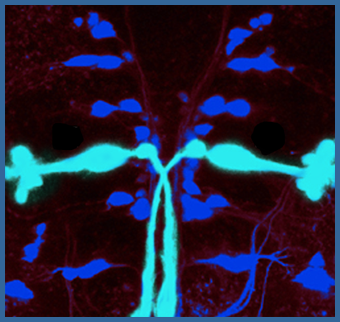
Image courtesy of https://www.tierphysiologie.uni-bayreuth.de
Axon navigation is aided by different endogenous guides. One of the most important are pioneering axons. Pioneering axons are a starting foundation to the laying down of new axons. It has been shown that these axons are first to develop and pioneer the axon tract which later developing axons will follow. Keshishan and Bentley (1983) carried out experiments on grasshoppers, focusing on sensory neurons in the distal part of the hind leg. They discoverd that laser ablation of Ti's (cells in the hind leg with pioneering axons processes) resulted in misguidence of sensory axons. For pioneering axons to fid its way correctly it relies on different stratagies.Guides